Vaccination has long been questioned by those with young children. The fear of negative side effects and the ethical issues that surround vaccinations often give parents pause before allowing the immunization of their children. While some of these concerns are valid, many supposed side effects have been disproven all together, while the risks of abstaining from vaccination have increased. The cost and preventative effectiveness of vaccination to combat the burden of disease is enough to convince most parents to approve immunizing their children.
Measles in Portland
Just north of Portland Oregon, on January 25th a public health state of emergency was declared for the entire state of Washington [1]. Measles, a disease targeted for world-wide eradication by 2020 by the World Health Organization, made a comeback [2]. The Measles is a preventable disease with the use of readily available inexpensive vaccines. Nonetheless, over two-hundred cases of the measles were recorded in North America, when it had previously been declared eradicated for the US [3]. This leaves the question, how did a preventable and seemingly eradicated infection cause an outbreak?
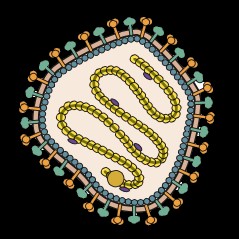
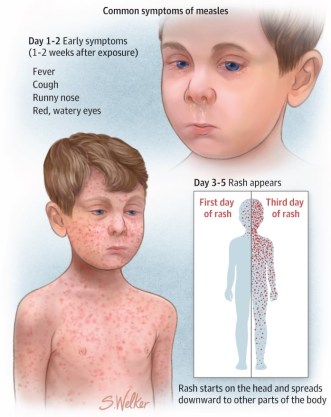
Such was the case in Washington State this year, which has a high density of anti-vaccine supporters (“anti-vaccers”). One case of the measles was all that was required for the infection to spread like wildfire. The incidence rates for Measles in Portland took a sudden and steady incline. This left the community with a striking pandemic from a disease that should have been left eradicated. Without vaccination, what would have not been an issue, caused a massive burden of disease in a community filled with susceptible children because of fearful parents. Now, their children are at a much higher risk for long term effects than they would have been with vaccination [6].
How Vaccines Work
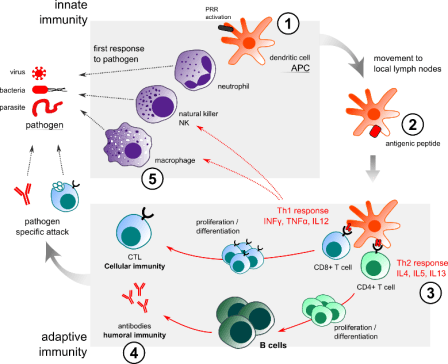
Vaccines utilize the immune system’s ability to recognize foreign invaders. Macrophages, T cells, and B cells are the main components of the immune system that make vaccines effective. When an antigen is found in the body, the macrophages and B cells respond. Macrophages, cells in the immune system, engulf and digest any foreign invader. As they digest the organism, they process the genetic information present in the pathogen, including the antigen. This information is then transmitted to the T-cells. T-cells are the lymphocytes which function in the immune system by playing a role in antigenic recognition. The antigenic information stored in the T-cells is paired with the B-cells in the immune response. B-cells are also lymphocytes, but unlike T-cells, B-cells produce antibodies. When a pathogen is present in the body, B-cells ingest some of these invaders. The T-cells paired with the B-cells provide the processed genetic information to efficiently produce antibodies [9]. B-cells have the potential to provide multiple antibodies, but once it has created an antibody for a specific antigen, it will be stored for future pathogens [9]. Vaccines utilize this system to introduce antigens for the body to create antibodies for, prior to any pathogenic effects.
MMR Vaccine
The Measles, Mumps, and Rubella (MMR) vaccine is a live, attenuated vaccine. The recommended dosage includes two treatments, with one at the first birthday and the second at least four to six years of age [11]. The vaccine is tested to be 97% effective with two doses [12]. In the US, the measles vaccine is made from the Moraten strain and is developed in chick embryo fibroblast cultures [13]. The virus is the attenuated and combined with the mumps and rubella components to form the MMR vaccine. The inactivated version of the vaccine was discontinued in the US. This is due to the development of a proclivity for atypical measles in those who received the inactivated vaccine [13]. The infection is a result of the weakening of the immune system by the inactivated virus. With subsequent exposure to the wild type virus, individuals developed a form of the Measles that took physiological effects differing from the common version of the Measles virus [13]. This left the live, attenuated version as the only effective option for the prevention of Measles.
As there are with any medicine, there are some side effects that come with the MMR vaccine. The most common side effects are fever and rash which typically only last a few days [13]. More rare side effects include allergic reactions, thrombocytopenia, lymphadenopathy, and arthralgias [13]. There is no definitive evidence to link the development of autism to the MMR vaccine to date [13]. The largest groups of concern receiving the vaccination are: those who are allergic to the neomycin component of the vaccine, those who are or may become pregnant, and those with immunodeficiency [13]. These individuals should consult a doctor before accepting the MMR vaccine.
Much of the concern in refusing vaccinations for children is their immune system’s teachability, as well as the concern for the development of autism. However, no evidence suggests any correlation between the MMR vaccine and the development of autism [13]. Beyond the concern of autism, the question of informed consent leaves many people questioning when vaccines should be administered. Within the first two years of life, the immune systems begins to rapidly develop. This happens by exposure to pathogens in the environment as well as naturally occurring bacteria. Fetal immunity is heavily dependent on antibodies provided by the mother [15]. These antibodies provide immune response to pathogens to which the fetus would be exposed and vulnerable to. As the fetus develops, the maternal antibodies start to diminish, leaving the child without defense against many pathogens [15]. Immunizing children at a young age helps to combat this vulnerability by providing antigens for immune response. The issue in waiting for consent is leaving the child unprotected to disease which could potentially have long term or fatal effects. The debate on vaccine timing is a fine balance between rights and protection.
Survey
Pockets of anti-vaccers, such as that in Portland can be found in many areas around the US. The student body of Toccoa Falls College in northeast Georgia was surveyed for their opinions on vaccine use and efficacy. This was done by randomizing the list of current students available and emailing the survey to their student email. The population of Toccoa Falls college includes residential and commuter students from the southeast US, as well as multiple national and international residential and online students. Dual enrolled high school students were also included in the survey.
The online survey consisted of nine questions regarding personal use and opinions on vaccine ethics. Additionally, each survey had a detailed informed consent agreement question, and only those with marked agreement were included in the study. Each response was collected without any personal identifiers and there was no benefit for participation in the survey. Responses were collected for a period of three weeks, and thirty-five responses were collected in total and included in the results.
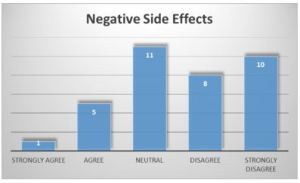
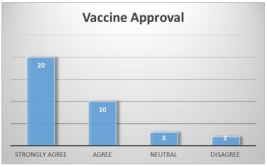
Participants were asked about general vaccine approval without specification of types of vaccines or conditions of usage. The question had available responses of strongly agree, agree, neutral, disagree, and strongly disagree. 85% of the population marked that they approve of vaccine use as shown in Figure 1. There was only 10% of the population that marked neutrality, with no strong disapproval responses. This suggests that the majority affirms vaccine usage. However, the issue becomes more complicated when the potential for negative side effects comes into question. 51% of the population surveyed marked that they did not think vaccines can cause negative side effects such as autism as shown in Figure 2. 31% of the population remained neutral on the question. This suggests a lack of education on the subject.
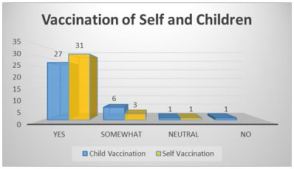
Individuals have a tendency to mirror the decisions that their parents have made in regards to their health. 89% or responders marked that they had been vaccinated and 71% of responders marked that they would vaccinate their children as shown in figure 3. This is a majority in the positive response for both categories. Furthermore, there was no response of any unvaccinated individual and there was only a single marked response reflecting that they would not vaccinate their children.
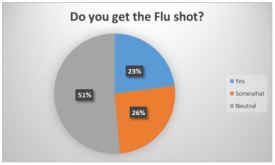
The Flu shot works in the same way that typical vaccinations operate. This would suggest that there should be a similar rate of influenza vaccination as there is for regular vaccination. However, this is not the case. When the population was asked if they receive the flu shot annually, 51% responded that they received the flu shot, with 23% marking that they do not receive the flu shot at all, as shown in Figure 4. This shows a large difference between the 85% of the population that marked their approval of vaccines. This would suggest that there is a large difference in the approval, and willingness to act on their approval. Other factors such as accessibility and finances may also be a part in their decision. Since there was no option for explanation of any answer, the cause of the difference in approval and action cannot be determined and would require further study.
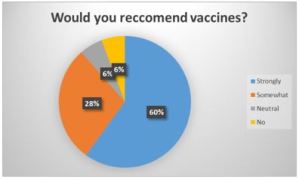
Participants were also asked if they would recommend vaccines to others. 60% of responders marked that they would strongly recommend vaccines, with 28% marking that they would somewhat recommend vaccines. This means that 88% responded that they would recommend vaccines at least somewhat, while only 6% said they would not as shown in figure 5. This is a 3% increase from those who affirmed vaccines in the first question. More responders marked that they would recommend vaccines than those who marked that they approved of vaccines.
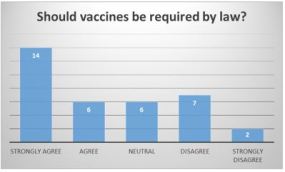
The population’s response was more evenly spread when asked if vaccinations should be required by law. 57% agreed with the statement, with 25% disagreeing, as shown in figure 6. The majority still lies with those who affirm vaccination by law, but the difference in percentiles is significantly lower. This suggests that while individuals understand that vaccines are beneficial, there should still be some element of personal choice in the use of vaccines.
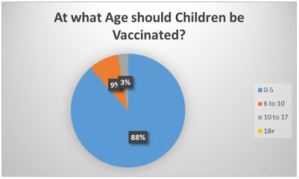
With personal choice in the use of vaccines, comes the question of what age children should be vaccinated at, as well as who should decide if a child get vaccinated. Participants were provided with some background information (see addendum) regarding the issues of declining immune response with a child’s increasing age. When asked at what age children should be vaccinated, 88% of responders marked that children should be vaccinated from ages 0-5, with 12% marking that they should be vaccinated at 5 and older, as shown in figure 7.
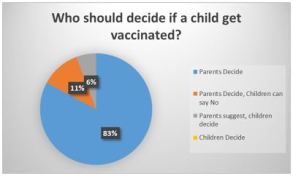
Participants were also asked who should decide if a child get vaccinated, with the options ranging from: ‘parents deciding, children denying’ to ‘parents suggests, and child decides.’ 83% of responders marked that parents should decide if a child received vaccines as shown in figure 8. This is consistent with the 85% of responders which marked that a child should be vaccinated within the first five years of life. If a child is vaccinated before their fifth birthday, the parents must decide. This is because the child does not have the ability to choose rationally. These results suggest that the population believes that vaccines should not be regulated by the government, but should be regulated by parents.
Conclusions
Vaccination ethics have been in debate for years. Wakefield’s study, although redacted within a few years after publication, was enough to seed doubt in the minds of many parents. The resulting decrease in vaccination rates has caused an unnecessary rise in disease incidence. This is especially true for the MMR vaccine, which was targeted by the original Wakefield study as a cause of autism. Regardless of its proclaimed eradication, in recent years, measles has become an increasing problem [2]. Pockets of anti-vaccine communities are at even higher risk for infection than unvaccinated individuals. Such was the case in Portland Oregon in the early months of 2019.
At Toccoa Falls College, in Northeast Georgia, opinions on vaccinations are more conservative with 85% general approval. The main motivation in the anti-vaccer movement is the belief that vaccines can cause autism to develop in children. There was 51% of the population that did not think that vaccines had negative side effects. The percent of those who also get their annual flu shot was significantly lower than those who approve of vaccines. These factors suggest that there is a lack of education on the subject. Individuals may not have a good understanding of how vaccines work, which would impact whether they agree with the negative side effects, and follow through in receiving vaccinations. Although Wakefield’s study was redacted, if individuals have not heard that fact, they are at risk for agreeing with the study. Financial and accessibility concerns may also be a factor in individuals’ choice for a flu shot. The flu shot in particular, tends to have a lower usage rate than other vaccines. This may be due to a lack of awareness of the flu shot and its quality as a vaccine. Regardless of the reason, there is clearly a deficit between affirming vaccine use and actually using vaccines.
Another gap shows up when looking at those who approve of vaccines verses those who would recommend vaccines. 88% of responders would recommend vaccines at least somewhat, while only 85% marked that they approve of vaccines.. This 3% difference means that more people would recommend vaccines than those who approve of them in general. The resulting 85% of those who would recommend vaccines is also in contention with the resulting 17% for those who agree with the negative side effects of vaccines. Regardless of the potential for negative side effects, the majority of the population recommends the use of vaccines. This data suggests that the population believes that vaccines are necessary even if they do have negative side effects. While there is some disconnect between the understanding of and use of vaccines, people generally understand that vaccines use in preventing disease outweighs any possibility for negative side effects.
The population of students at Toccoa Falls College also has some interesting opinions on who should decide if children are vaccinated. 57% thinks the government should require vaccination of children. While this is the majority, it still leaves a large minority who believe the government should not be involved in the process. Furthermore, 88% of the population responded that children should be vaccinated from ages 0-5 and 85% that parents should decide if their children are vaccinated. This shows that while the minority may not want the government to be involved in the decision, the majority believes parents should still be the ones to decide on vaccination. The benefits of vaccination and the protection offered, outweighs the complications of informed consent. If a higher risk factor were involved, the decision maker may shift from parents to children. This could be a potential problem based on the receptiveness of the immune system of the child, however, currently weighing the risk is still in the hands of the parents.
The outbreak in Portland is just one example of when abstaining from vaccination caused a major risk for an entire community. The majority of those at Toccoa Falls College are in affirmation for vaccine usage, however there are still some who do not approve of the usage of vaccines. This suggests that there needs to be some sort of additional vaccine education implemented. Vaccines do have side effects, but the risk for the diseases and infections that vaccines prevent is higher and of greater consequence. Educational programs have the potential to increase awareness, and in turn, decrease the incidence of disease. Vaccinations have the ability to save individuals and entire communities from diseases and their lasting effects. While the efficacy of vaccines may be in question, the impact they have on the incidence of infection is more significant than the risk any side effects possess. Faulty publications and questionable science gained a foothold over the past few years, and the damage that they have caused will take a considerable amount of work to reverse, but with consistent education, vaccines have the power to eradicate disease and save lives.
References
[1] State of Washington. PROCLAMATION BY THE GOVERNOR. [online] Available at: https://www.governor.wa.gov/sites/default/files/proclamations/19-01%20State%20of%20Emergency.pdf [Accessed 10 March 2019]
[2] World Health Organization. Measles. [online] Available at: https://www.who.int/immunization/diseases/measles/en/ [Accessed 10 March 2019]
[3] Centers for Disease Control and Prevention. Measles Cases and Outbreaks. [online] Available at: https://www.cdc.gov/measles/cases-outbreaks.html [Accessed 10 March 2019]
[4] Centers for Disease Control and Prevention. Signs and Symptoms. [online] Available at: https://www.cdc.gov/measles/about/signs-symptoms.html [Accessed 20 March 2019]
[5] Centers for Disease Control and Prevention. Complications of Measles. [online] Available at: https://www.cdc.gov/measles/about/complications.html [Accessed 20 March 2019]
[6] National Institute for Neurological Disorders and Stroke. Subacute Sclerosing Panencephalitis Information Page. [online] Available at: https://www.ninds.nih.gov/Disorders/All-Disorders/Subacute-Sclerosing-Panencephalitis-Information-Page [Accessed 20 March 2019]
[7] Hussain, Azhar et al. The Anti-vaccination Movement: A Regression in Modern Medicine Cureus vol. 10,7 e2919. 3 Jul. 2018. [online] Available at: https://www.ncbi.nlm.nih.gov/pmc/articles/PMC6122668/ [Accessed 20 March 2019]
[8] Wakefield, AJ et al. Ileal-lymphoid-nodular hyperplasia, non-specific colitis, and pervasive developmental disorder in children. Lancet 28 Feb. 1998. [online] Available at: https://www.ncbi.nlm.nih.gov/pubmed/9500320 [Accessed 20 March 2019]
[9] Goldstein, Natalie. Vaccines. Facts on File, Inc, 2010. [online] Available at: EBSCOhost, proxygsu-toc1.galileo.usg.edu/login?url=http://search.ebscohost.com/login.aspx?direct=true&db=nlebk&AN=357599&site=eds-live&scope=site. [Accessed 22 March 2019]
[10] Centers for Disease Control and Prevention. Understanding how Vaccines Work. [online] Available at: https://www.cdc.gov/vaccines/hcp/conversations/downloads/vacsafe-understand-color-office.pdf [Accessed 22 March 2019]
[11] Centers for Disease Control and Prevention. MMR (Measles, Mumps, & Rubella) VIS. [online] Available at: https://www.cdc.gov/vaccines/hcp/vis/vis-statements/mmr.html [Accessed 22 March 2019]
[12] Centers for Disease Control and Prevention. Measles Vaccination. [online] Available at: https://www.cdc.gov/measles/vaccination.html [Accessed 22 March 2019]
[13] Centers for Disease Control and Prevention. Pink book: Measles. [online] Available at: https://www.cdc.gov/vaccines/pubs/pinkbook/meas.html [Accessed 23 March 2019]
[14] Centers for Disease Control and Prevention. MMR and MMRV Vaccine Composition and Dosage. [online] Available at: https://www.cdc.gov/vaccines/vpd/mmr/hcp/about.html [Accessed 22 March 2019]
[15] Simon, KA, et. al. Evolution of the immune system in humans from infancy to old age. [online] Available at: https://www.ncbi.nlm.nih.gov/pmc/articles/PMC4707740/ [Accessed 25 March 2019]
[16] National Public Radio. Measles Cases Mount In Pacific Northwest Outbreak. [online] Available at: https://www.npr.org/sections/health-shots/2019/02/08/692665531/measles-cases-mount-in-pacific-northwest-outbreak [Accessed 10 March 2019]
[17] Virology Blog. Looking for the next measles virus. [online] Available at: http://www.virology.ws/2019/01/24/looking-for-the-next-measles-virus/ [Accessed 8 April 2019]
[18] Thompson, A.E. Recognizing Measles. [online] Available at: https://jamanetwork.com/journals/jama/fullarticle/2275448 [Accessed 8 April 2019]
[19] OZ Bioscience. For Vaccination Research. [online] Available at: https://www.ozbiosciences.com/content/46-vaccine-adjuvants-vaccinationresearch [Accessed 8 April 2019]
[20] Centers for Disease Control and Prevention. Antigenic Characterization. [online] Available at: https://www.cdc.gov/flu/professionals/laboratory/antigenic.htm [Accessed 8 April 2019]
[21] Daily Beast. NBA Fans May Have Been Exposed to Measles at Portland Trail Blazers Game. [online] Available at: https://www.thedailybeast.com/nba-fans-may-have-been-exposed-to-measles-at-portland-trail-blazers-game [Accessed 8 April 2019]
 Science Made Easy